How to Start a Cloud Kitchen From Home in India: 9 Steps and What It Costs
Last updated: October 2026
How to start a cloud kitchen from home comes down to nine things, and the first one costs nothing.
Cook one dish really well. Price it properly. Get an FSSAI registration. Then get it photographed, listed and in front of people nearby.
Most guides skip the part you need most — what it costs. So: real rupee numbers at every step, and an honest answer on whether you're allowed to do this from home.
The short answer
- ₹33,000 at the honest minimum, ₹51,000 to ₹1.32 lakh to do it properly. No rent, no deposit
- FSSAI Basic Registration is enough to start — ₹100 a year, and you apply yourself
- GST is compulsory from your first order on Zomato or Swiggy
- One cuisine, eight to twelve dishes. Not forty
- Photography matters more than branding. It's your only shopfront
- A ₹300 order earns ₹96 through an aggregator, ₹180 if ordered directly
START FREE — NO CARD NEEDED
Bill, track stock and see what's selling from day one. Runs in your browser — no hardware to buy.
Can you legally run a cloud kitchen from home?
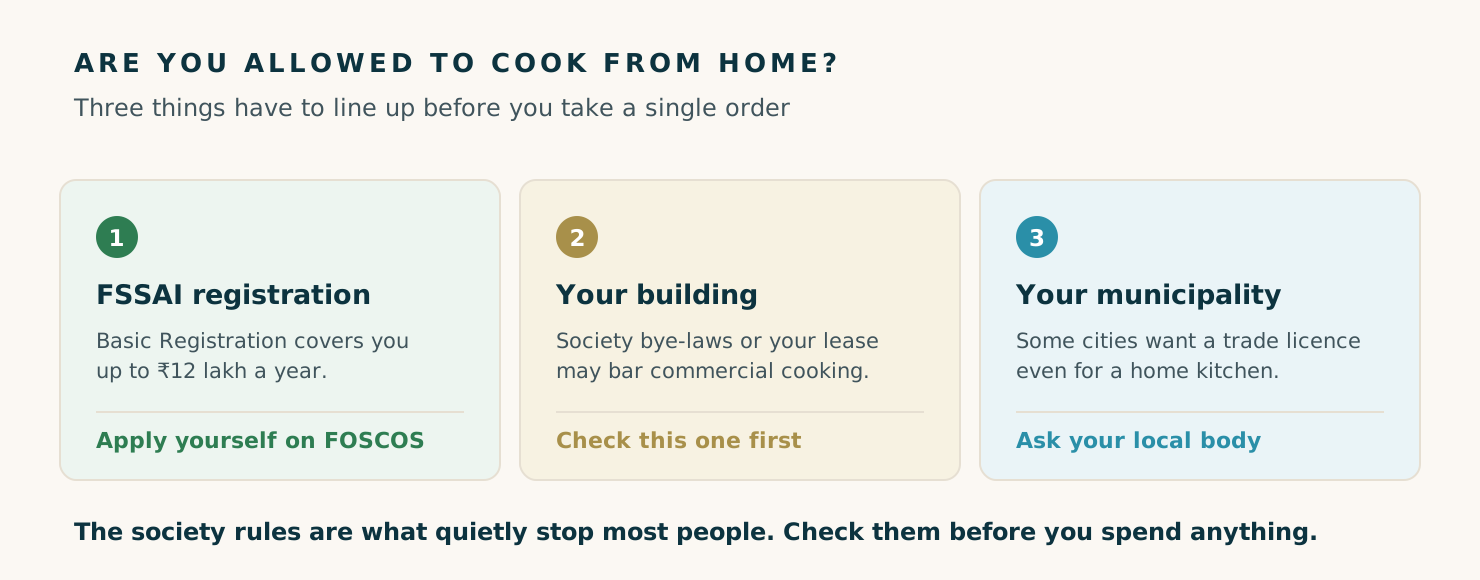
In most of India, yes — but three things must line up.
FSSAI. You need a Basic Registration, which costs ₹100 a year and which you apply for yourself on the FoSCoS portal. No delivery app will list you without it.
Two things changed in March 2026 that most guides miss. Registration is now perpetual — no renewal date — but it's suspended if you miss the annual fee or a return. And the turnover ceiling was raised, so check the current figure on FoSCoS. A home kitchen sits well under it either way.
Catering is the exception. Caterers are excluded from Basic Registration at any turnover and need a State Licence.
Your building. Societies and leases sometimes bar commercial activity. Check your bye-laws first — this is what quietly stops most people.
Your municipality. Some cities want a trade licence even for home kitchens. Rules vary by state, so ask your local body.
Get this right from day one: keep prep separate from family cooking, raw apart from cooked. Home inspections are rare; hygiene complaints on an aggregator are not, and those suspend listings.
What it costs to start from home
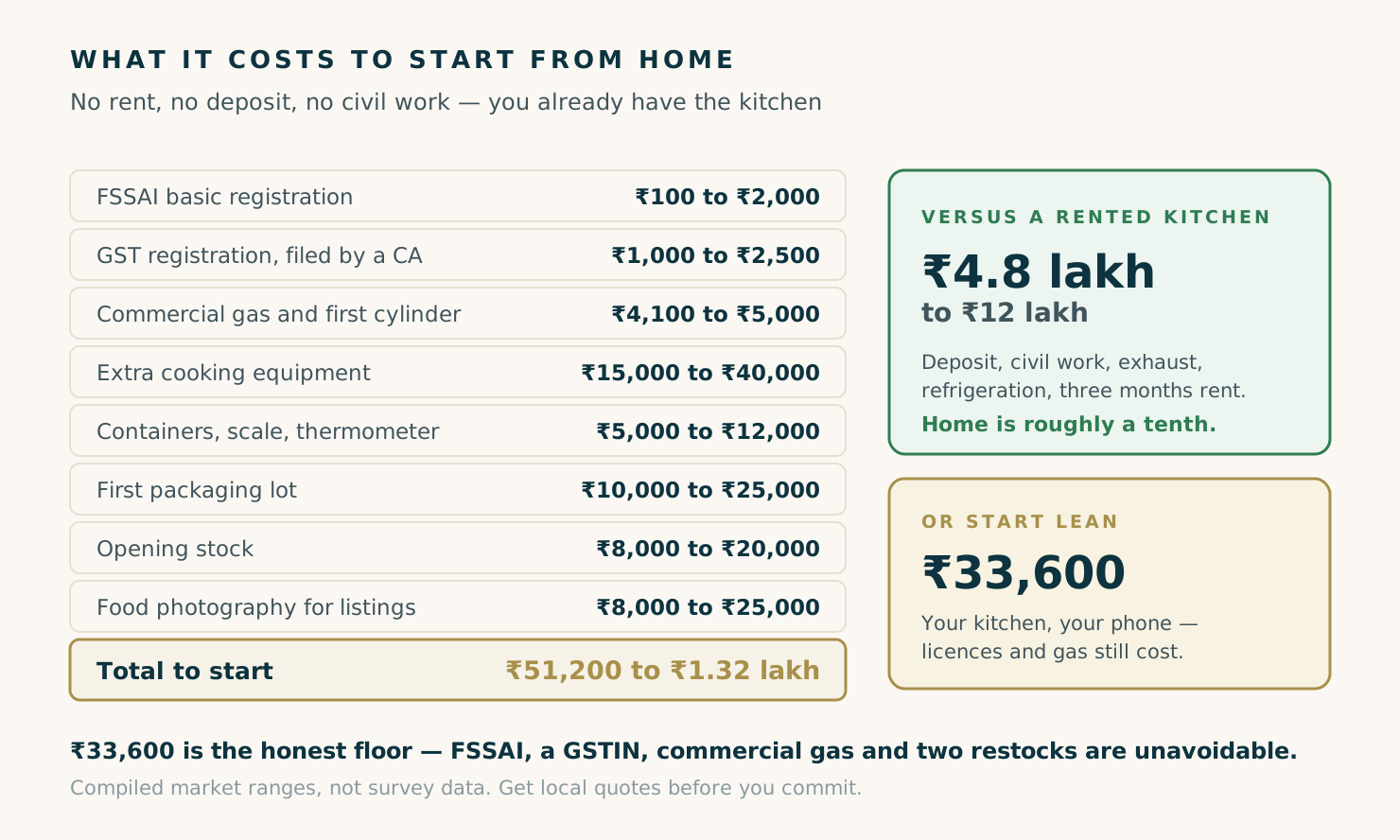
This is the number nobody prints. You already have a kitchen, so most of a normal cloud kitchen build disappears.
₹51,200 to ₹1.32 lakh to start, line by line in the breakdown above.
The licences are the small part — ₹5,200 to ₹9,500 covers FSSAI, GST registration and a commercial gas connection. Equipment, packaging, opening stock and photos are where the rest goes, and every one of those four has a cheap version.
Billing software sits on top at around ₹499 a month, not a one-time cost.
A rented commercial kitchen runs ₹4.8 lakh to ₹12 lakh — full breakdown in our cloud kitchen setup cost guide. Home is how you find out people want your food before signing a lease.
These are compiled market ranges, not survey data. Get local quotes before you commit.
Can you start for less? Yes — about ₹33,000.
Use the kitchen and the phone you already own and the list gets short. It does not get as short as the internet tells you:
| What you need | Cost |
|---|---|
| FSSAI Basic Registration | ₹100 |
| GST registration, filed by a CA | ₹1,500 |
| Commercial gas connection, deposit and papers | ₹2,000 |
| First 19 kg commercial cylinder | ₹2,100 |
| 200 containers with lids | ₹3,000 |
| Carry bags, tape, FSSAI-number stickers | ₹1,000 |
| Two large vessels for batch cooking | ₹2,500 |
| Weighing scale | ₹800 |
| Airtight storage jars | ₹1,500 |
| Opening stock, one short menu | ₹5,000 |
| Photos, shot on your own phone | ₹0 |
| Kit, licences and first stock | ≈ ₹19,500 |
| Two restocks before your payouts settle | ₹12,000 |
| Second gas refill | ₹2,100 |
| Cash you actually need | ≈ ₹33,600 |
Three of those rows are the ones nobody prints.
- A GSTIN is not optional. You can trade below the threshold on your own, but Zomato and Swiggy will not onboard a kitchen without one — so the day you list, you need it
- A domestic cylinder is for domestic cooking. Cook for sale on one and you are using it against the rules — and in Himachal they have been seized from eateries. A commercial connection is roughly ₹4,000 to get going
- Payouts land about a week behind the order. You restock twice before the money settles into a rhythm. Start with exactly the kit money and you run dry in week two
The ₹51,000 version buys a second burner, proper storage and a real photo shoot — worth it once orders are steady, not in week one.
Skip all of this for the first six months: a website, an agency logo, printed custom packaging, a deep freezer, paid ads on the aggregator, and anyone selling you a "cloud kitchen franchise".
SOFTWARE THAT FITS A HOME BUDGET
No setup fee, no bundled hardware, no annual lock-in. See exactly what each plan includes before you spend anything.
The 9 steps
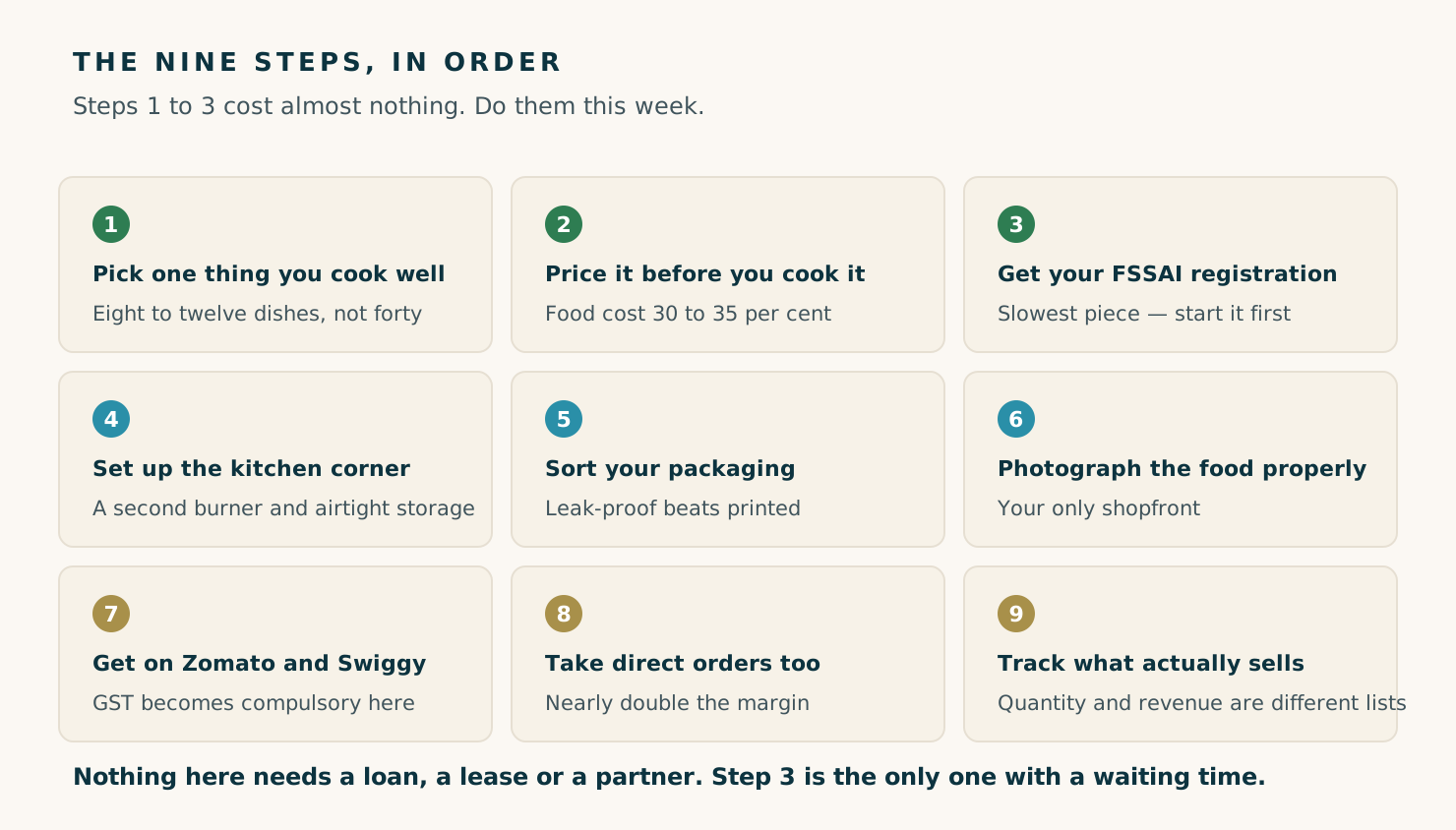
1. Pick one thing you cook well
Not a cuisine. One dish, then build eight to twelve around it.
- Less stock, less waste, less equipment — and it sells better, because forty-item listings get scrolled past
- Pick something that travels well. Gravies, biryanis and bakes survive thirty minutes; dosas and fried items don't
2. Price it before you cook it
Cost out one plate first. Most home kitchens price by guesswork, then find out months later they're losing on their bestseller.
- Add up every ingredient for one portion
- Target food cost at 30 to 35 per cent of the selling price, remembering the aggregator takes 18 to 25 per cent on top
The same arithmetic later tells you which dishes to push and which to drop — covered in our guide to increasing restaurant sales.
3. Get your FSSAI registration
- Apply on the FoSCoS portal — online, and you do it yourself
- Basic Registration, ₹100 a year. Since March 2026 it has no expiry, but missing the annual fee or a return suspends it
- Keep the certificate handy. Zomato and Swiggy both ask for it during onboarding
- Do this first. It gates everything else
4. Set up the kitchen corner
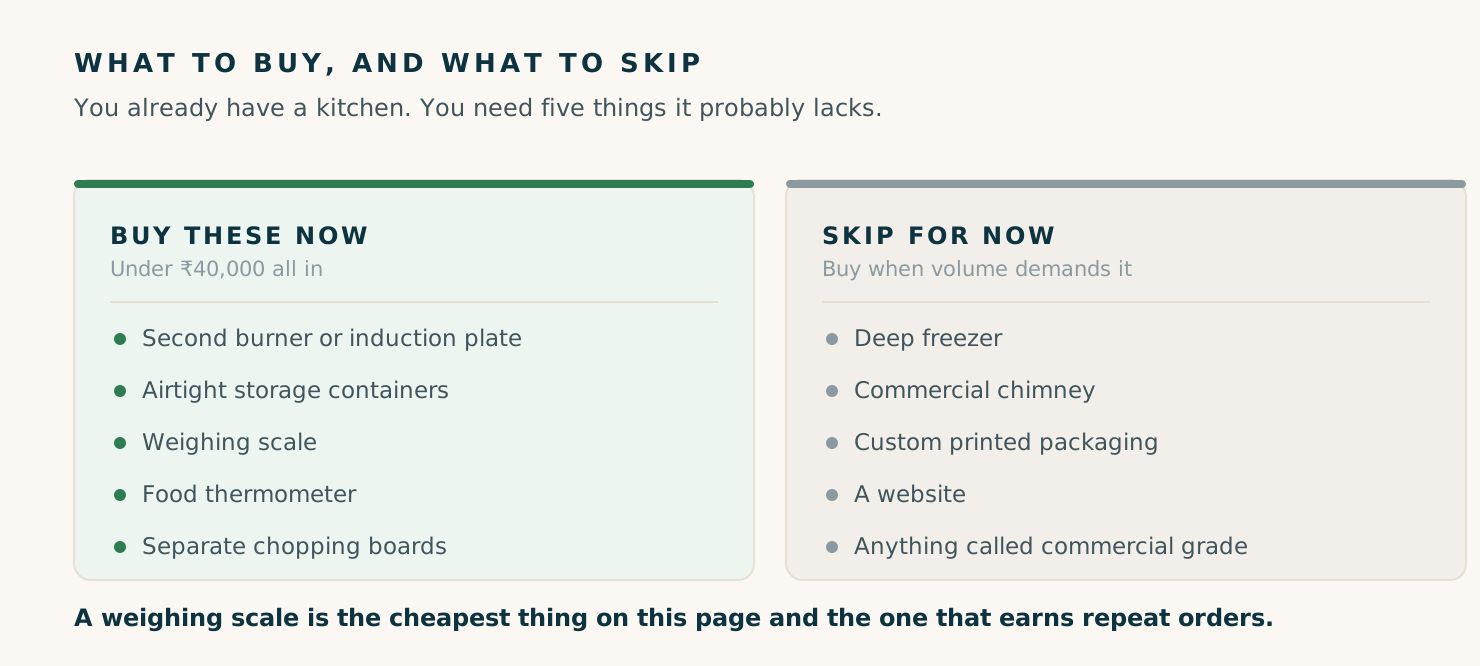
You don't need a commercial kitchen — a dedicated corner and a few things your home kitchen probably lacks:
- A second burner or induction plate, so family cooking doesn't block you
- Airtight storage containers, labelled and dated
- A weighing scale — portion consistency is what earns repeat orders
- A food thermometer, and separate boards for raw and cooked
5. Sort your packaging
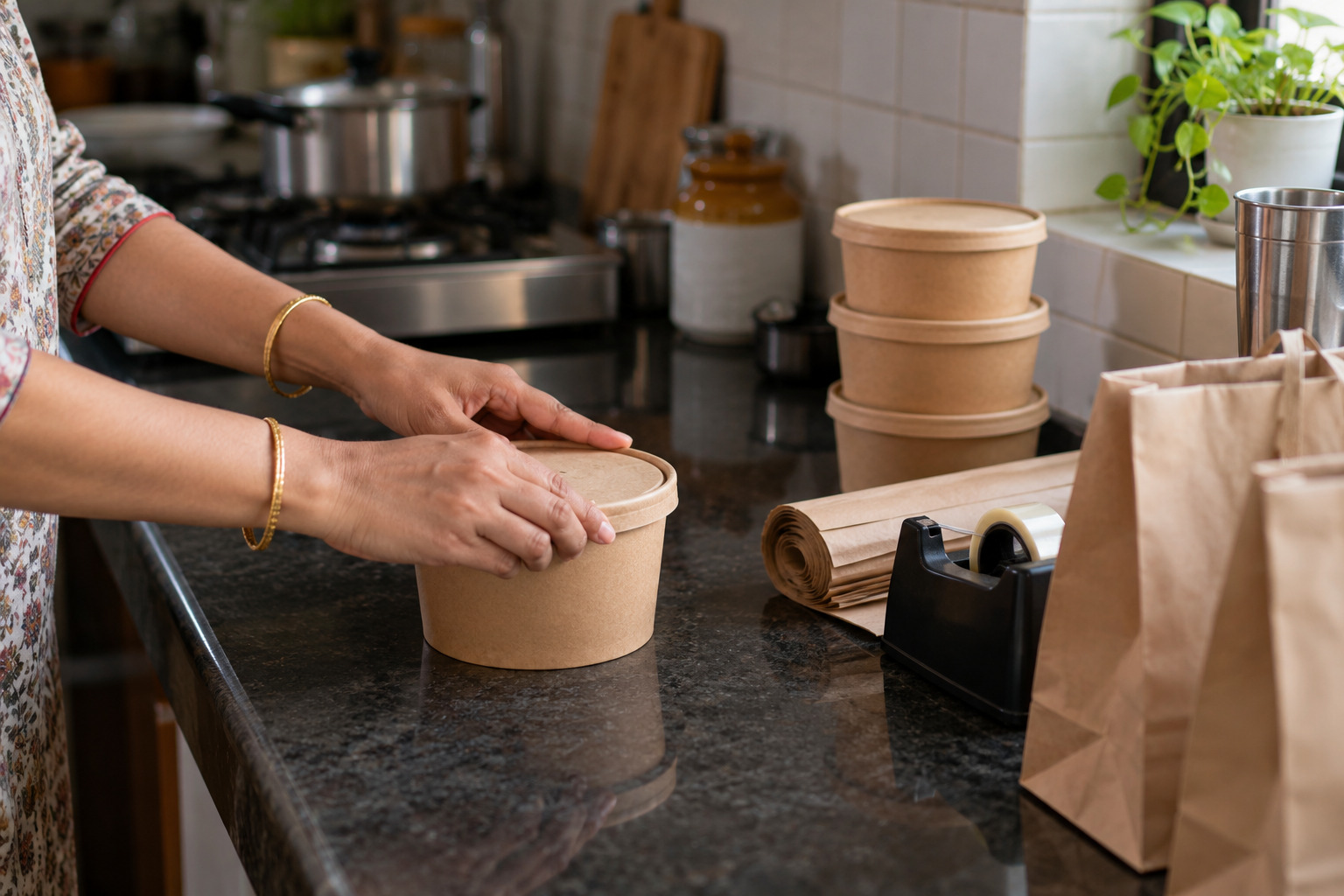
Packaging is where home kitchens lose money and reviews.
- Leak-proof containers. One spilled gravy is a one-star review
- Printed boxes often carry a 1,000-unit minimum per size
- Start with plain containers and a sticker. Printing can wait until you know your sizes
6. Photograph the food properly
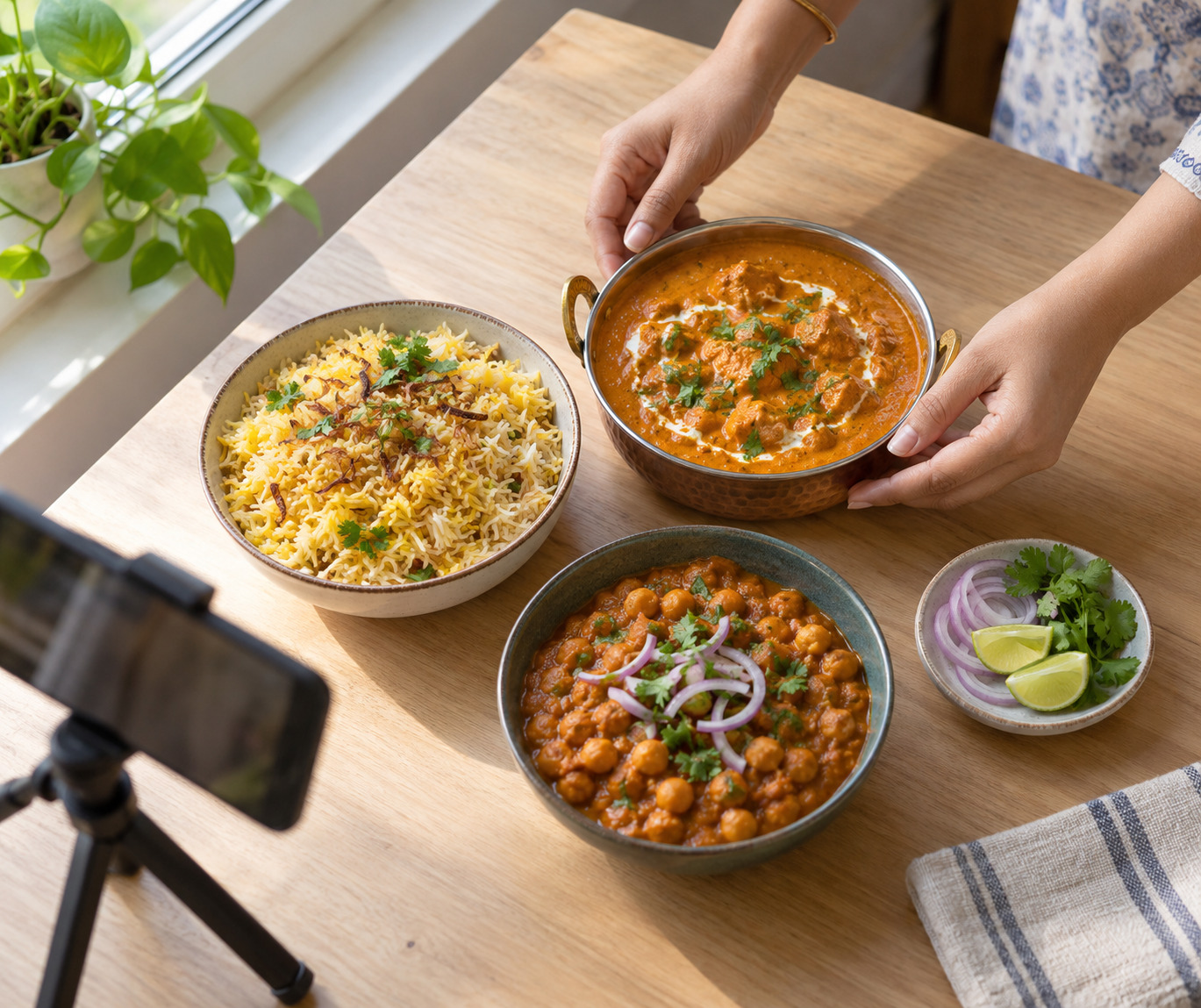
On a delivery app your photo is the entire shopfront — no building, no signboard, no smell of food.
- Natural light near a window, mid-morning. Top-down and at 45 degrees, plated the way it arrives
- Twelve dishes shot properly beats a logo every time
If you do pay for a shoot, ₹8,000 to ₹25,000. It's the highest-return rupee you'll spend.
7. Get on Zomato and Swiggy
- Register as a restaurant partner on either platform's site
- You'll need the FSSAI certificate, GST registration, PAN and a bank account
- GST is compulsory from order one, whatever your turnover. Onboarding takes one to three weeks
The platform pays the 5% GST on your food, not you — but you still report the sale. Our billing software guide covers what a compliant invoice carries.
YOUR MENU ON THEIR PHONE
Guests scan and order directly. No app for them to download, and no commission on the order.
8. Take direct orders too
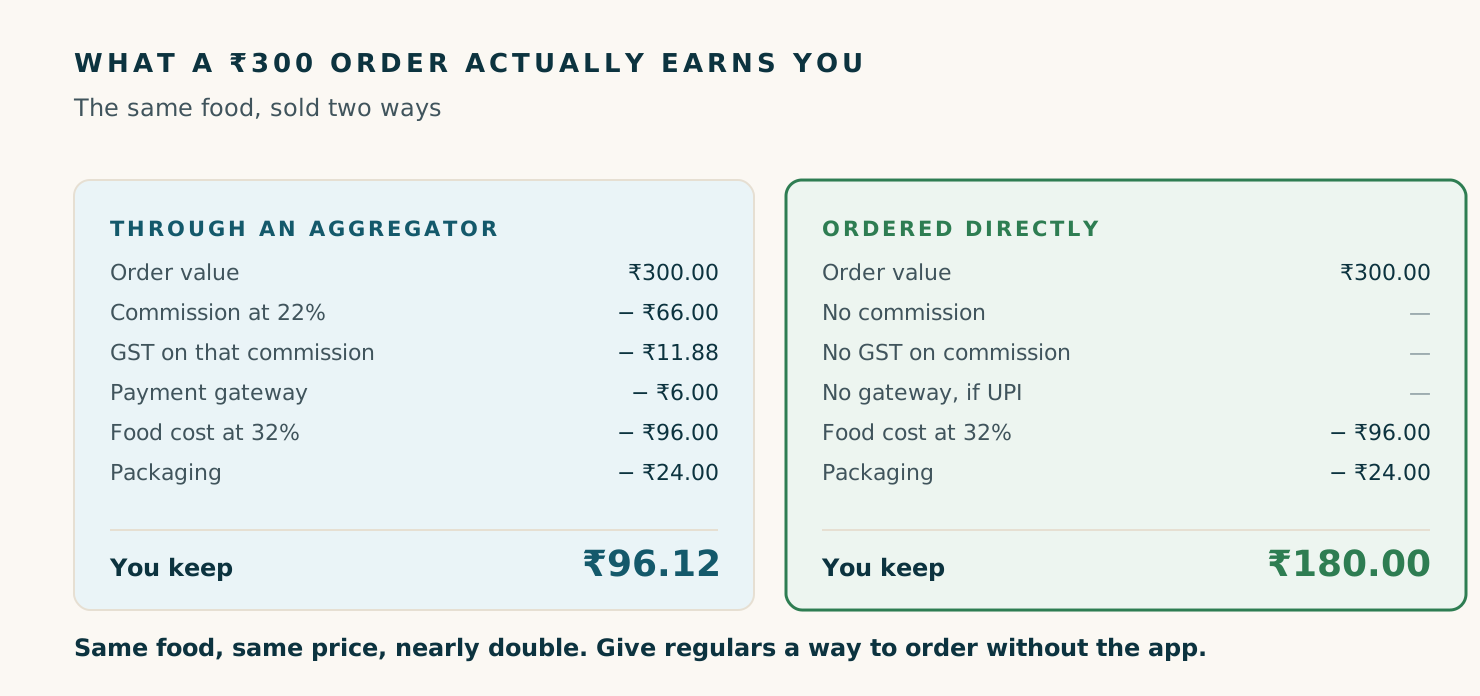
The arithmetic on a ₹300 order, and it's the most important thing here.
| Through an aggregator | Amount |
|---|---|
| Order value | ₹300.00 |
| Less commission at 22% | ₹66.00 |
| Less GST on that commission | ₹11.88 |
| Less payment gateway | ₹6.00 |
| Less food cost at 32% | ₹96.00 |
| Less packaging | ₹24.00 |
| You keep | ₹96.12 |
Take it directly — a WhatsApp message, a digital menu they scan, a phone call — and you keep ₹180.
Same food, same price, nearly double. Give regulars a way to order without the app.
FIFTEEN MINUTES, YOUR NUMBERS
Bring your menu and your costs. We'll work out what you'd actually keep per order — no slide deck.
9. Track what actually sells
Most home kitchens run on memory, then can't answer basic questions. Track three things:
- Which dishes sell, by quantity and by revenue — different lists
- Food cost percentage, monthly
- Aggregator orders versus direct orders
A notebook works. Software is easier, because it falls out of billing — our POS software guide lists what to test on a demo.
When to move out of your home kitchen
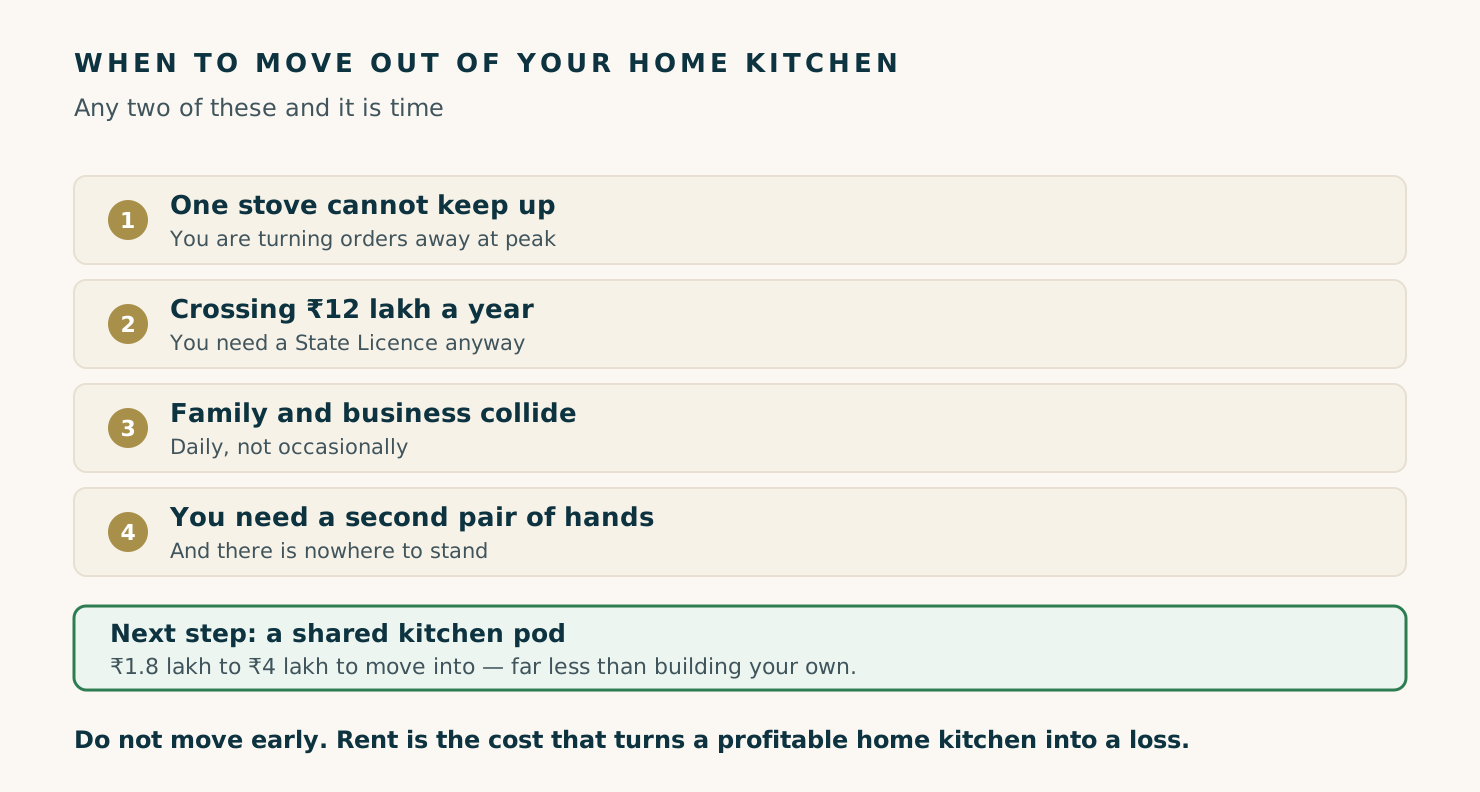
Any two of these mean it's time:
- You're turning down orders because one stove can't keep up
- You've started taking catering or bulk orders — that needs a State Licence, whatever your turnover
- Family cooking and business cooking are colliding daily
- You need a second pair of hands, and there's nowhere for them to stand
A shared pod costs ₹1.8 lakh to ₹4 lakh to move into — far less than building your own. You'll also be hiring, which our restaurant staff guide covers.
What CurryIQ is, and how it helps
CurryIQ is restaurant software that runs in your browser. Nothing to install, no machine to buy — which matters when your whole budget is ₹33,000. For a home kitchen it does four things:
It makes GST-compliant bills. List on an aggregator and your invoices have to be right from order one — the format is handled.
It gives guests a menu they can order from directly. A QR code, or a WhatsApp link. That's the gap between keeping ₹96 and ₹180 on a ₹300 order — the biggest lever on this page.
It counts your stock. What you used, what's left, what to reorder — so food cost is visible, not a month-end guess.
It tells you what sold. Which dishes, by quantity and by revenue — the two lists that decide what you push and drop.
Starter is ₹499 a month, free onboarding, no card for the trial — about a third of one day's earnings at 15 orders a day.
TRY IT BEFORE YOU SPEND A RUPEE
Set up your menu, send a test bill, see the numbers. No card, no onboarding fee, nothing to install.
Frequently asked questions
Can I start a cloud kitchen from home in India?
Yes, in most places. You need FSSAI Basic Registration, permission from your society or landlord, and in some cities a trade licence. Check the society rules first.
How much does it cost to start a cloud kitchen from home?
About ₹33,000 if you use the kitchen and phone you already have — roughly ₹19,500 of licences, kit and opening stock, plus ₹14,100 of restocking and gas before your aggregator payouts settle. Doing it properly runs ₹51,000 to ₹1.32 lakh.
Do I need GST registration for a home cloud kitchen?
Selling directly, not until ₹20 lakh — ₹10 lakh in Himachal, Uttarakhand and the North East. But Zomato and Swiggy will not onboard you without a GSTIN, so the day you list, whatever your turnover, you need one.
Which FSSAI licence do I need?
Basic Registration to start — ₹100, applied for by you on FoSCoS. Since March 2026 it has no expiry, but missing the annual fee or a return suspends it. The turnover ceiling was raised in 2026, so confirm the current figure there. Caterers are the exception and need a State Licence at any turnover.
How much can a home cloud kitchen earn?
Roughly ₹96 on a ₹300 aggregator order after commission, GST on it, gateway, food and packaging. At 15 orders a day that's about ₹43,000 a month before your own time. Direct orders nearly double it.
What food works best for a home cloud kitchen?
Anything that survives thirty minutes in a bag — biryanis, gravies, bakes, desserts, tiffin. Fried food and anything that must stay crisp doesn't.
Where to start
Three things this week:
- Pick your one dish and cost out a single plate
- Start the FSSAI registration on FOSCOS — it's the slowest piece
- Shoot it near a window and see if the photo makes you hungry
Ready for the commercial version? Our cloud kitchen setup cost guide has the full numbers.
Connecting the delivery apps is covered in the cloud kitchen POS guide.
BUILT IN INDIA, FOR INDIAN KITCHENS
GST billing, QR ordering and stock tracking that runs in a browser. Free onboarding, nothing to install, cancel anytime.
General guidance, not legal or tax advice. FSSAI rules changed in March 2026 and GST rules differ by state — confirm the current position on [FoSCoS](https://foscos.fssai.gov.in) and with your CA before you start trading.
Keep reading
Ready to try CurryIQ?
Start free. No credit card required. Setup in 10 minutes.